When we first saw the numbers on DeepSeek V4.1-Flash, we thought someone had made a typo. A model that performs almost as well as GPT-6 Astra, but costs about 1.4% of the price? That doesn't sound real.
But it is. And it dropped on September 10, 2026.
The AI community has been buzzing ever since. We've spent the last few days digging through the benchmarks, the architecture docs, and the pricing tables. What we found is genuinely impressive and honestly, a little disruptive.
Let's break down what this model actually is, why it matters, and what it means for anyone building with AI.
What Exactly Is DeepSeek V4.1-Flash?
DeepSeek V4.1-Flash is the newest model from the Chinese AI company DeepSeek. It's a 552-billion-parameter mixture-of-experts model that replaces both the previous V4-Flash and V4-Flash-Vision-Exp models.
But here's what makes it different from the typical model update.
This isn't just an incremental upgrade. DeepSeek built it on an entirely new architecture called Causal Encoder-Decoder. The key insight is asymmetry—the model activates just 8 billion parameters for input and 16 billion for output. That's a fraction of its total size, which means it runs faster and cheaper than models of comparable capability.
It also comes with native multimodal visual understanding built right in. You can feed it images and text together, and it'll understand both. No separate vision pipeline needed.
If you're a developer or a business looking at AI costs, this architecture is the reason those costs just dropped dramatically.
The Numbers That Have Everyone Talking
The benchmarks tell the story better than we ever could. Here's what the data shows.
Benchmark | DeepSeek V4.1-Flash |
GPQA Diamond | 90.9 |
Terminal-Bench 2.1 | 90.6 |
DeepSWE v1.1 | 74.2 |
CyberGym | 88.1 |
HLE (with tools) | 63.9 |
Codeforces Rating | 3471 |
MathArena Apex | 65.6 |
Chartography (with tools) | 78.9 |
BabyVision (with tools) | 89.6 |
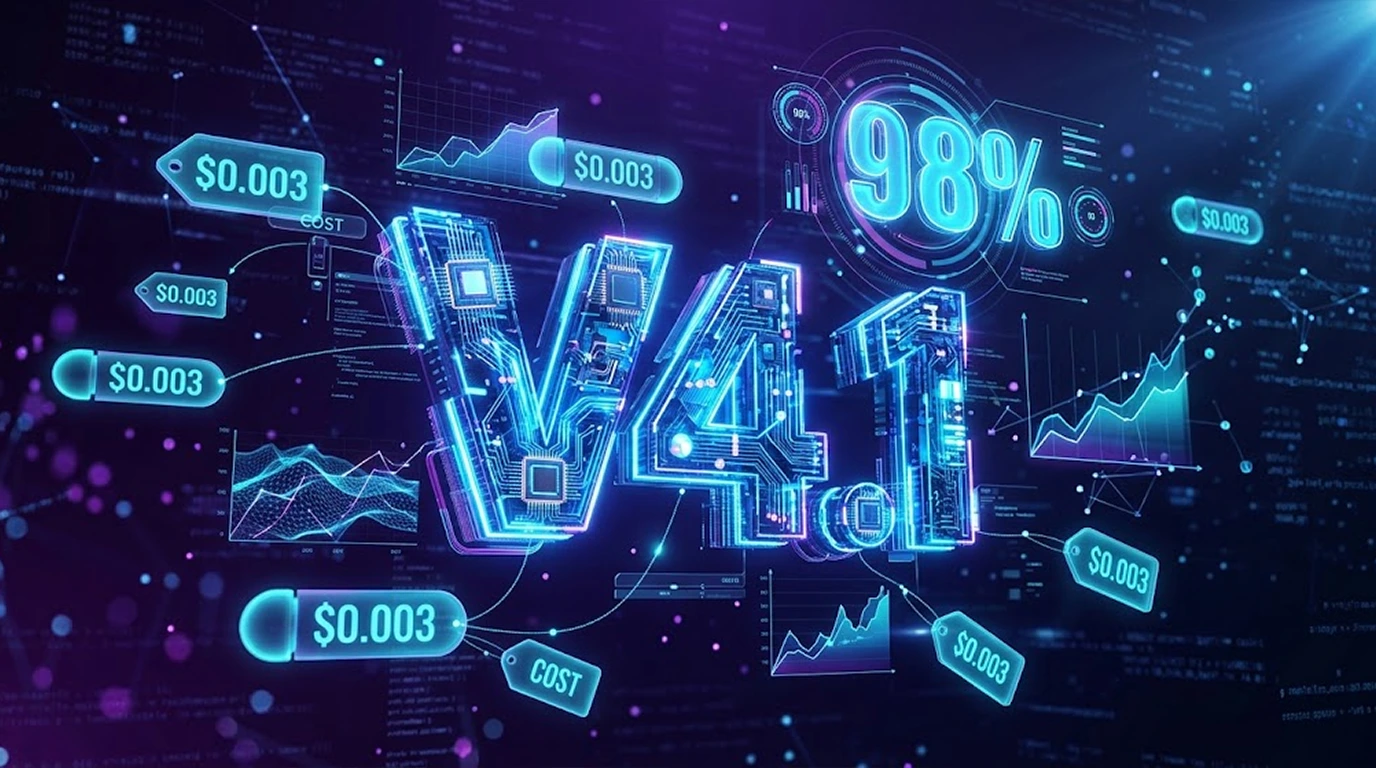
On OpenDesign's public design arena, V4.1-Flash scored 81.2 points. GPT-6 Astra, OpenAI's flagship model, scored 82.7. That's 98% of the performance.
But here's where it gets really interesting. V4.1-Flash finished the task in 5.3 minutes. Astra took 11.1 minutes. And the cost? V4.1-Flash was $0.023 per task. Astra was $1.61.
That's not a typo. That's about 1.4% of the cost.
We had to read that twice too.
Why It's So Cheap: The KV Cache Story
This is the technical part that makes everything else possible. And honestly, it's kind of brilliant.
When AI agents work on long tasks, they constantly re-read the same context. System instructions, conversation history, tool definitions. This repeated reading creates something called "KV cache" costs, and for agent workloads, these can account for a huge portion of your bill.
DeepSeek's innovation? They compressed the KV cache down to about 890 bytes per token. That's roughly one-quarter of the previous V4-Flash model. SSD storage requirements dropped to one-eighth.
They achieved this through FP4 quantization, cross-layer sharing, and a redesigned caching system that reduces the memory footprint without sacrificing capability.
The practical result? Cache-hit input costs dropped to $0.003 per million tokens during off-peak hours. That's not a typo either.
Think about what that means for an agent that repeatedly works against the same codebase or document. The cost of remembering what it already read just became almost negligible.
DeepSeek V4.1-Flash Pricing
Let's just put the pricing on the table. No spin. No marketing language. Just the numbers.
Pricing Tier | Cache Hit Input | Cache Miss Input | Output |
Off-Peak | $0.003 / 1M | $0.15 / 1M | $0.60 / 1M |
Peak | $0.006 / 1M | $0.30 / 1M | $1.20 / 1M |
Peak hours run Monday through Friday, 01:00–04:00 UTC and 06:00–10:00 UTC. Everything else, including all weekends, is off-peak.
To put that in context, OpenAI's GPT-5.6 Sol charges $4 per million input tokens and $20 per million output tokens. Anthropic's Claude Opus 5 charges $5 and $25 respectively.
Even at peak rates, DeepSeek V4.1-Flash is a fraction of the cost.
Open Weights and the MIT License
Here's something else that matters. V4.1-Flash isn't just available through DeepSeek's API. The model weights are open on Hugging Face, released under an MIT License.
That means you can download it, run it on your own hardware, modify it, and use it commercially. No restrictions. No royalties. No permission needed.
For enterprises that need to keep data on-premises or have strict compliance requirements, this is a massive deal. You get frontier-level performance without sending sensitive data to a third-party API.
What Happened to V4-Pro (And Why You Should Care)
DeepSeek made a bold move alongside this release. They announced that V4-Pro, their previous flagship model, is being phased out.
Starting September 14, 2026, all API requests to deepseek-v4-pro are being automatically routed to V4.1-Flash at Flash prices.
Let's say that again. The company's old premium model is being retired in favor of its new budget model. Because the budget model is better.
That's not a typical product strategy. But it's a signal of how much progress they've made with this architecture.
How to Access DeepSeek V4.1-Flash
If you want to try it, here's how.
Through the API: Set your model to deepseek-flash in your API calls. The model supports Chat Completions, Responses, and Anthropic-compatible APIs. It works with JSON output, tool calls, and chat prefix completion.
Through Hugging Face: The weights are available at deepseek-ai/DeepSeek-V4.1-Flash. You'll need about 510 GB of storage for the model files.
Through partners: WorkBuddy, including CodeBuddy, and OpenCode now fully support V4.1-Flash.
Context window: 1 million tokens. Max output: 384,000 tokens.
The Bottom Line
DeepSeek V4.1-Flash isn't just another model release. It's a statement about where AI economics are heading.
The performance gap between "frontier" models and "budget" models is closing fast. And when a model can deliver 98% of the quality at 1.4% of the cost, while being open-source and MIT-licensed, it forces everyone to rethink their assumptions.
If you're building AI agents, running large-scale inference, or just trying to keep your API bill under control, this model deserves your attention.
The economics just changed. And DeepSeek is the one who changed them.
FAQ Section
What is DeepSeek V4.1-Flash?
DeepSeek V4.1-Flash is a 552-billion-parameter multimodal AI model released on September 10, 2026. It uses a new Causal Encoder-Decoder architecture and is designed for high capability at low cost.
How much does DeepSeek V4.1-Flash cost?
Off-peak pricing is $0.003 per million tokens for cache hits, $0.15 for cache misses, and $0.60 for output. Peak rates are double those figures.
Is DeepSeek V4.1-Flash open source?
Yes. The model weights are available on Hugging Face under an MIT License, allowing commercial use and modification.
How does DeepSeek V4.1-Flash compare to GPT-6 Astra?
On OpenDesign's design arena, V4.1-Flash scored 98% of GPT-6 Astra's performance at about 1.4% of the cost. It also completed tasks in roughly half the time.
What happened to DeepSeek V4-Pro?
DeepSeek is phasing out V4-Pro. Starting September 14, 2026, all API requests to V4-Pro are being routed to V4.1-Flash at Flash prices.
Does DeepSeek V4.1-Flash support images?
Yes. It is equipped with native multimodal visual processing capability, which means it can process both texts and images.
What is KV cache and why does it matter?
KV cache stores context that AI agents repeatedly reference. DeepSeek compressed it to about 890 bytes per token, reducing cache-hit costs to $0.003 per million tokens off-peak.
What is the context window of DeepSeek V4.1-Flash?
It supports a 1-million-token context window with up to 384,000 output tokens.
Can I run DeepSeek V4.1-Flash on my own hardware?
Yes. The open weights are available on Hugging Face. You'll need about 510 GB of storage for the model files.
What API formats does DeepSeek V4.1-Flash support?
It supports Chat Completions, Responses, and Anthropic-compatible APIs, along with JSON output, tool calls, and chat prefix completion.