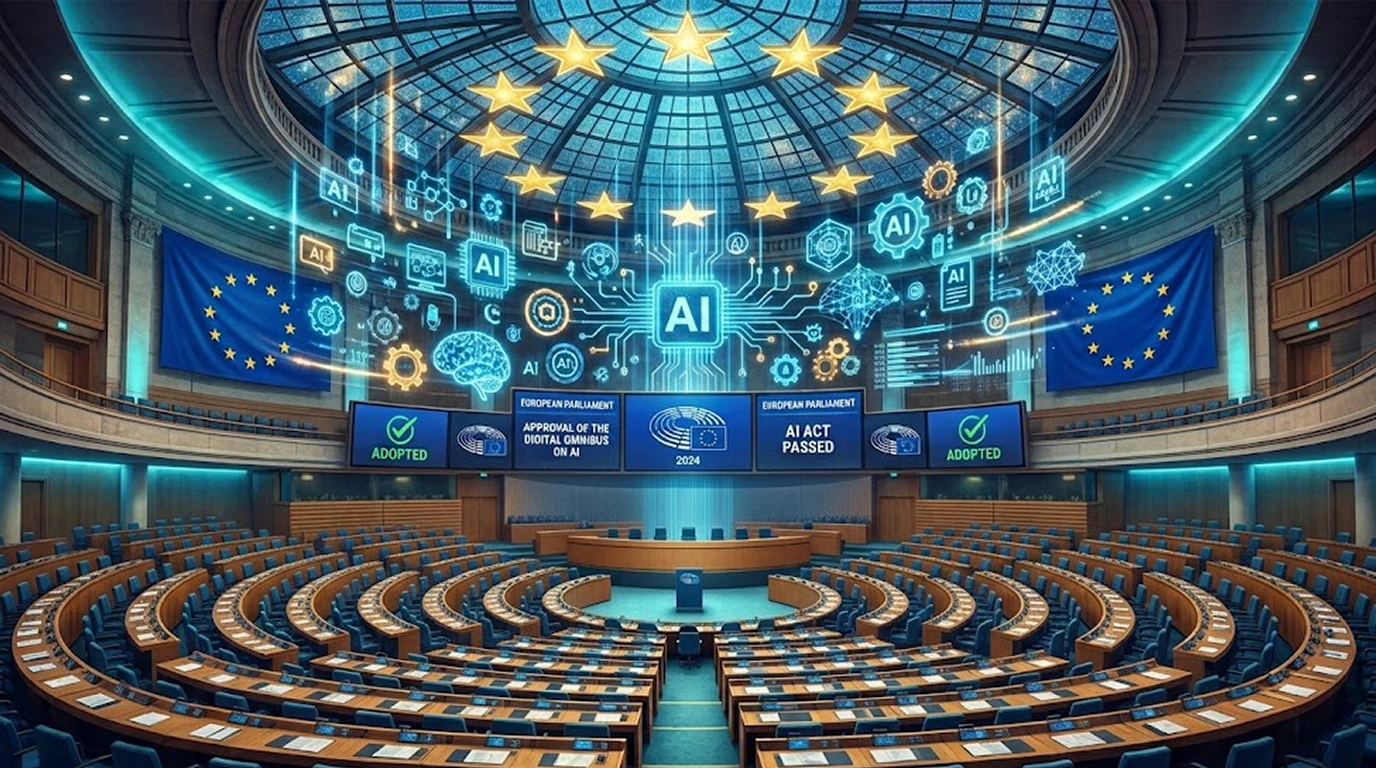
Let's consider one thing which is quite trending in the technology circle.
Recently, European Union has done something unique. They simplified their AI rules to make things easier for businesses while also banning something pretty controversial, AI apps that create fake nude images of people without their consent.
Yes, you read that right.
On one hand, the EU is saying "let's make it easier for companies to innovate with AI." On the other hand, they're saying "absolutely not" to certain harmful uses of the technology.
Let's break down what actually happened and what it means for you.
What Is the Digital Omnibus on AI?
Back in November 2025, the European Commission proposed something called the Digital Omnibus on AI.
It is simply a package of changes intended to simplify the EU AI Act, which is the big law that regulates artificial intelligence in Europe. The intention was quite simple; making the regulations easy to implement for businesses while still safeguarding the rights of its citizens.
The Commission, Parliament, and Council reached a political agreement on May 7, 2026. The European Parliament made its final endorsement on June 16, 2026, where it received 423 votes for, 57 votes against, and 174 abstentions. The regulation came into effect on July 27, 2026.
Such changes are in line with the EU’s broader simplification agenda. They wanted to reduce administrative burden and boost Europe's competitiveness in AI.
The Big Change: Deadlines Are Being Pushed Back
Here's the most practical change for businesses.
Originally, the rules for high-risk AI systems were supposed to apply from August 2, 2026. But there was a problem, the technical standards and support tools weren't ready. Member States hadn't even designated their national authorities yet.
So the EU did something sensible. They pushed back the deadlines.
New timeline for high-risk AI rules:
AI System Type | New Compliance Date |
Stand-alone high-risk AI systems | December 2, 2027 |
High-risk AI systems embedded in products (like toys or lifts) | August 2, 2028 |
The idea is to give everyone more time to get things right. Companies can prepare properly. Standards can be finalized. Regulators can set up their systems.
This isn't about weakening the rules. It's about making sure the rules are actually implementable.
What's This Ban on Nudification Apps?
This is probably the most talked-about part of the changes.
The EU has added a new prohibition to the AI Act. It bans AI systems that generate non-consensual sexually explicit content or child sexual abuse material.
What specifically is banned:
AI tools that create realistic images, videos, or audio of identifiable people's intimate parts without their consent
AI systems that generate child sexual abuse material
"Nudification" apps that fake nude images of real people
Who this applies to:
Providers can't place these systems on the EU market unless they have adequate technical safeguards to prevent misuse
Deployers using these systems for prohibited purposes are also covered
Timeline: Companies have until December 2, 2026, to bring their systems into compliance.
The co-rapporteur for the legislation put it bluntly: these apps affect real people, overwhelmingly women, with the goal of humiliating and degrading them. The Parliament fought for this ban, and it'll be in effect before the end of the year.
What Else Changed?
SME and Small Mid-Cap Support
The agreement extends certain privileges from small and medium-sized enterprises to small mid-cap companies. They shall benefit through simpler requirements concerning documentation and more focused assistance.
Machinery Products – Clarification of the Rules
There have been concerning how the AI Act applies to product safety laws, especially in terms of the Machinery Regulation. The Omnibus clarifies this to avoid duplication and double regulation for innovators.
Regulatory Sandboxes
More innovators will get access to regulatory sandboxes controlled environments where they can test their AI solutions in real-world conditions. There will even be an EU-level sandbox.
AI Office Powers Strengthened
The Commission's AI Office gets enhanced oversight powers for general-purpose AI models and very large online platforms.
AI Literacy Requirement Reinstated
The final agreement reinstates the obligation for providers and deployers to ensure a sufficient level of AI literacy among their staff. The Commission had first suggested that it be voluntary but Parliament reversed that.
Detection of Bias
The regulation makes provision for exceptional processing of sensitive personal data to detect and correct bias in the AI system to avoid discrimination while maintaining privacy safeguards.
Quick Look: What Changed and When
Change | Detail | Timeline |
High-risk rules (stand-alone) | Now apply Dec 2027 instead of Aug 2026 | December 2, 2027 |
High-risk rules (embedded in products) | Now apply Aug 2028 instead of Dec 2027 | August 2, 2028 |
Nudification apps ban | New prohibition on non-consensual intimate content | December 2, 2026 |
AI literacy obligation | Reinstated in final agreement | Already in force |
SME/SMC support | Extended privileges | Already in force |
AI sandboxes | More access, including EU-level | Already in force |
What This Means for Your Business
If you're developing AI in Europe, this is generally good news.
More time to comply: The extended deadlines mean you don't have to rush. Use the additional time for compliance purposes.
Clarity will help comprehend an issue better: The rules are more clear-cut compared to legislation.
Benefit for smaller firms: If you are an SME or small mid-cap firm, you get some regulatory relief.
One big warning: If you're involved with any technology that could be used for nudification or generating intimate content without consent, you need to act fast. The ban takes effect December 2, 2026, and you need to ensure your systems have adequate technical safeguards.
FAQ Section
What is the Digital Omnibus on AI?
This is a package of changes to the EU AI Act, which was introduced in November 2025, aimed at simplify the rules, reduce administrative burden, and boost innovation while maintaining protections.
When do the new high-risk AI rules apply?
Stand-alone high-risk AI systems: December 2, 2027. High-risk systems embedded in products: August 2, 2028.
What is nudification?
Here is another example of AI that generates nude pictures of individuals without any consent. Such applications are considered illegal within the European Union.
When will the nudification ban come into force?
The nudification ban will be in place from December 2, 2026.
Are there any exceptions for SMEs?
Yes. Simplification in documentation and further benefits for SMEs and small mid-cap businesses.
What is AI regulatory sandbox?
An environment where a company can test its AI solution under actual circumstances.
Will it weaken the regulation of AI?
No. This makes the regulation simpler without removing the necessary rights protections. The prohibition of nudification will in fact make those protections stronger.
What is the literacy requirement for AI?
The providers and deployers of AI systems are required to have a high level of AI literacy among their staff.