You've probably heard about generative AI. Maybe you've even used it. But if someone asked you to explain what it actually is or how it works, could you?
Most people can't. And that's totally fine because this stuff gets technical fast.
Let me break down generative AI in plain language, no computer science degree required.
What Makes Generative AI Different
Traditional AI is like a really good organizer. It organizes things, classifies information, and finds patterns in data which already exists. When your email catches spam before you see it, that's traditional AI at work. When your phone unlocks with your face, that's also traditional AI doing what it does best.
Generative AI does something completely different.
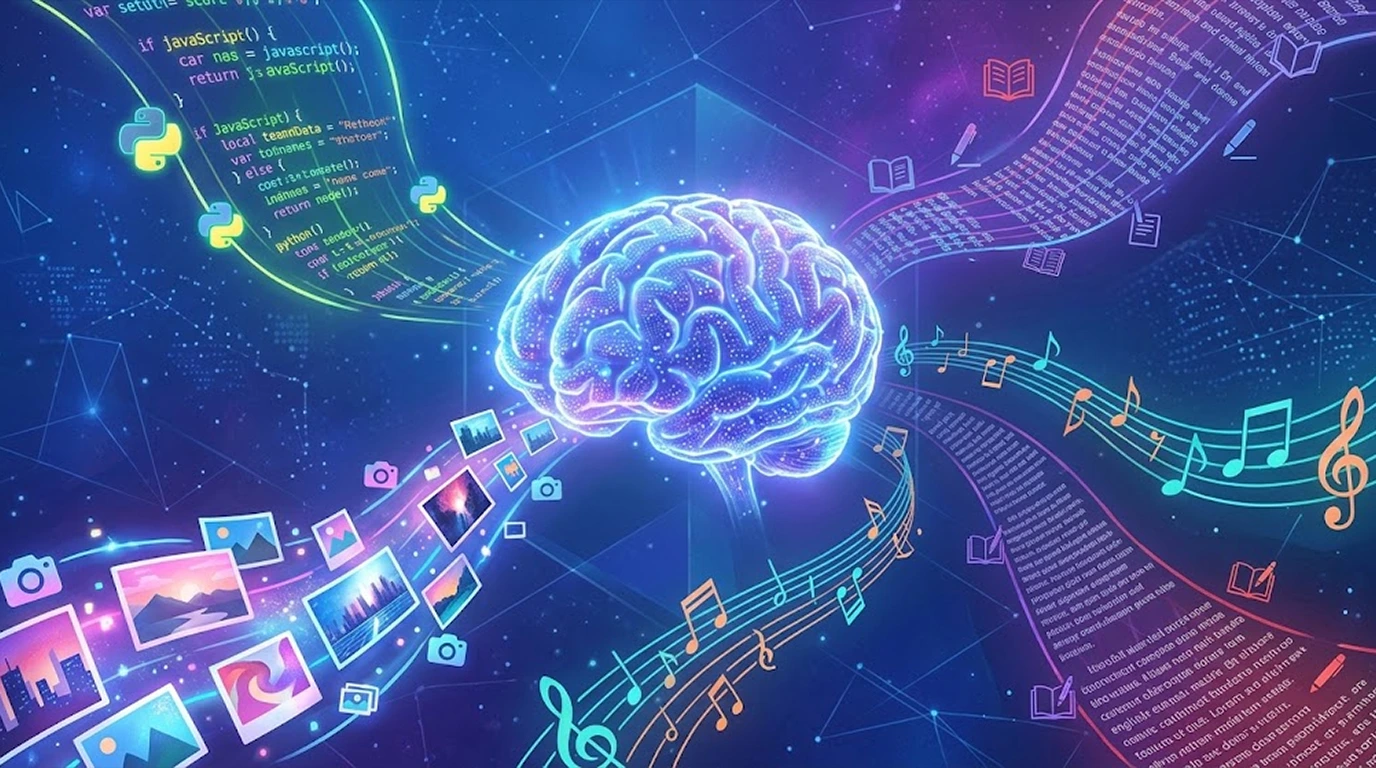
Generative AI is different because it does not just recognize patterns but also generates completely new content. Texts, graphics, audio recordings, videos, source code, anything that was learned to it during training.
Here's a simple way to think about generative AI: traditional AI is the person who can analyze a painting and tell you everything about it, generative AI is the artist who can paint something completely new.
This shift from "understanding" to "creating" is why generative AI is such a big deal and why everyone seems to be talking about it.
How Generative AI Actually Works
The underlying technology of generative AI isn't as complicated as it sounds. Here is how it goes.
Training Phase
In the first phase, a huge amounts of data are being fed to the generative AI model. We're talking billions of examples. Books, articles, images, code, music, whatever the model is designed to create.
As this training is going on, the generative AI analyzes patterns and relationships in all that data. It understands that some words come after other words, some colors go well together, some shapes make an object recognizable.
But here's the crucial thing about generative AI: it doesn't "understand" any of this the way we do. It's not reading and comprehending. Instead, it's building a giant statistical map of probabilities.
The Prediction Phase
After completing the training of the generative AI, the next phase will be to have a prediction engine.
When you prompt it to do something such as "write a poem about autumn" or "generate an image of a cat wearing a hat" the generative AI predicts what the appropriate response should be.
It analyzes your prompt, checks its probability map, and generates content that fits.
It is worth noting that generative artificial intelligence cannot think creatively in the way humans do. It is simply making statistically smart guesses about what content could fit your request. There is no awareness, there is no real understanding involved in generative AI; there is only advanced mathematics.
What Makes Modern Generative AI So Powerful
The breakthrough that made generative AI tools like ChatGPT possible was something called the transformer architecture.
Without getting too technical, transformers process language differently than older systems. Unlike word-by-word analysis, they do a joint examination of the words. In the end, it turns out that generative AI has become very good at contextual analysis.
Some of the mechanisms used in generative AI include:
Self-Attention generative AI uses self-attention mechanism to know which parts of your input are most important. If you write "the dog chased the ball and it bounced," self-attention helps the generative AI understand that "it" probably refers to the ball, not the dog.
Positional encoding helps the generative AI model understand word order since the sequence of words matters for meaning.
Most of the generative AI models you've heard of Google's Gemini, Anthropic's Claude, the ones powering ChatGPT all use transformer-based architectures.
What Generative AI Can Create
Different generative AI models do different things. Here's what's possible:
Text and code: This is what generative AI tools like ChatGPT, Claude, and Gemini do best. Any process involving language: writing, summarization, translation, programming.
Visuals: Artificial Intelligence models which have been able to generate images based on the text provided to them, for example Midjourney, DALL-E, Stable Diffusion. Want a photo of a dog surfing? Type it in and watch generative AI create it.
Audio: Generative AI can make music, synthesize voices, and even recreate voices from reference samples.
Video: Generative AI for videos is currently a new technology area, although it is already able to generate videos and animations based on text input.
Multi-modal generative AI models: The new trend in generative AI is multi-modal AI that deals with several types of data simultaneously. One generative AI model that understands text and images, or one prompt that generates an image, a description, and an audio clip all together.
Why Generative AI Matters
How People Are Actually Using Generative AI
Generative AI is already integrated into tools you probably use every day.
When your spell check understands complete sentences instead of just individual words, that's generative AI.
When chatbots answer your questions on websites, that's generative AI.
When the social media algorithms know what content you'll like, that too is an application of generative artificial intelligence.
In business, companies are using generative AI to automate tasks, create content at scale, and make faster decisions.
Marketers use generative AI to generate campaign copy.
Generative AI is used by developers to accelerate coding process.
Generative AI is also used by customer service departments to answer common questions without human interference.
Productivity Boost from Generative AI
Generative AI is extremely useful for time-saving when performing repetitive work tasks. Rather than doing everything from scratch, generative AI allows the creation of a draft, which can then be improved upon.
This isn't about replacing human judgment with generative AI. It's about amplifying what people can accomplish using generative AI.
Generative AI works best as what experts call a "tool that augments human creativity, problem-solving, and innovation." It does all the hard work so that humans can concentrate on important things.
Important Limitations of Generative AI
Generative AI isn't perfect. Not even close.
However, since the technology of Generative AI relies on making predictions based on patterns, there are times when it fails to make accurate predictions. There are many cases in which the Generative AI models can provide highly convincing information that is totally incorrect. This is known as hallucination, and it's one of the biggest challenges in the field of generative AI right now.
Generative AI also reflects the biases present in its training data. Should there be any biased patterns within the data, then the generative AI would produce similar biased outputs. This is a serious ethical concern that researchers are actively working on.
None of this means generative AI isn't useful. It just means you need to use generative AI with awareness. Verify important information from generative AI. Remember that AI is a tool rather than a substitute for human judgment.
Where AI Generators Are Heading To
AI Generators are progressing at an extremely rapid pace. The models have become more accurate and reliable.
Agentic generative AI, which is able to accomplish multi-step tasks autonomously, without being continuously guided by humans, is also on the rise. This may very well become the next big shift in generative AI.
But the fundamentals of generative AI remain the same: it creates content based on learned patterns. Generative AI doesn't think, it doesn't understand, it predicts. Understanding this about generative AI is the key to using it well.
FAQ Section
What is generative AI in simple terms?
Generative AI refers to technology which develops new content like text, images, audio, video, and codes through learning patterns from training datasets. Unlike traditional AI, generative AI does not analyze or classify the existing information, but rather generates new content.
What different generative AI from traditional AI?
Unlike traditional AI, which makes decisions and predictions based on the existing data, generative AI creates new content from scratch. Traditional AI identifies spam, generative AI writes emails. Traditional AI recognizes faces, generative AI draws entirely new portraits.
How does generative AI learn?
Generative AI models are trained on huge data sets. They identify the structure, pattern, and relations within data. By training, generative AI creates statistical maps that can predict what kind of response should be expected on prompting.
Are generative AI models intelligent?
No, they are not. Generative AI does not have consciousness, intelligence, or even thinking capabilities. The predictions made by AI are made depending on statistical patterns in the data used during the training process. Intelligence, when used in generative AI, means function and not actual intelligence.
What are some of the dangers involved in the use of generative AI?
Some of the dangers of generative AI are hallucinations, that is, false information; bias reflected from training data, and potential misuse for spreading misinformation or generating harmful content. Responsible use and verification are essential with generative AI.
What is to come in the future in the field of generative AI?
The future of generative AI will witness reliable systems with minimal errors, improved fact-checking abilities, greater transparency in making decisions, and also agentic generative AI that will be able to perform multi-step tasks on its own.
Can I use generative AI for free?
Yes. There are many generative AI tools which have free versions. AI generation tools such as ChatGPT, Claude, Gemini, and others are readily available for free.
Does one need to have technical expertise to use generative AI?
No. Most generative AI tools are designed for everyone. You just type what you want and the generative AI generates it. No coding knowledge required for using generative AI.
Is generative AI replacing human creativity?
No. AI generation enhances creativity of humans without replacing it. While the technology takes care of repetitive processes and produces the first draft, it requires human intervention, editing, and vision while dealing with generative AI.
How precise is generative AI?
Its precision will depend on the subject and the generative AI model in use. Generative AI is mostly precise with general subjects but less accurate with niche subjects. Always ensure the accuracy of vital information generated by generative AI through reliable sources.