What first comes to your mind when you think of "AI"?
For most people, it's something like ChatGPT. You type a question, it gives you an answer. You ask for help, it provides suggestions. You need a draft, it writes one.
That's what we've gotten used to over the past few years. A helpful assistant that answers questions and generates content.
But here's the thing, that's just the beginning.
We have moved into a totally new stage of AI. One where AI doesn't just talk to you. One where AI actually does things for you.
Welcome to the era of agentic AI.
What Actually Is Agentic AI?
Let's start with the simple definition.
"Agentic AI" means AI systems which can take their own tasks and make decisions without always requiring human supervision.
In other words: Agentic AI is where the AI takes action. It doesn't just give you suggestions. It actually does stuff.
Think about the difference between an assistant who tells you what you need to do and an assistant who just does it for you.
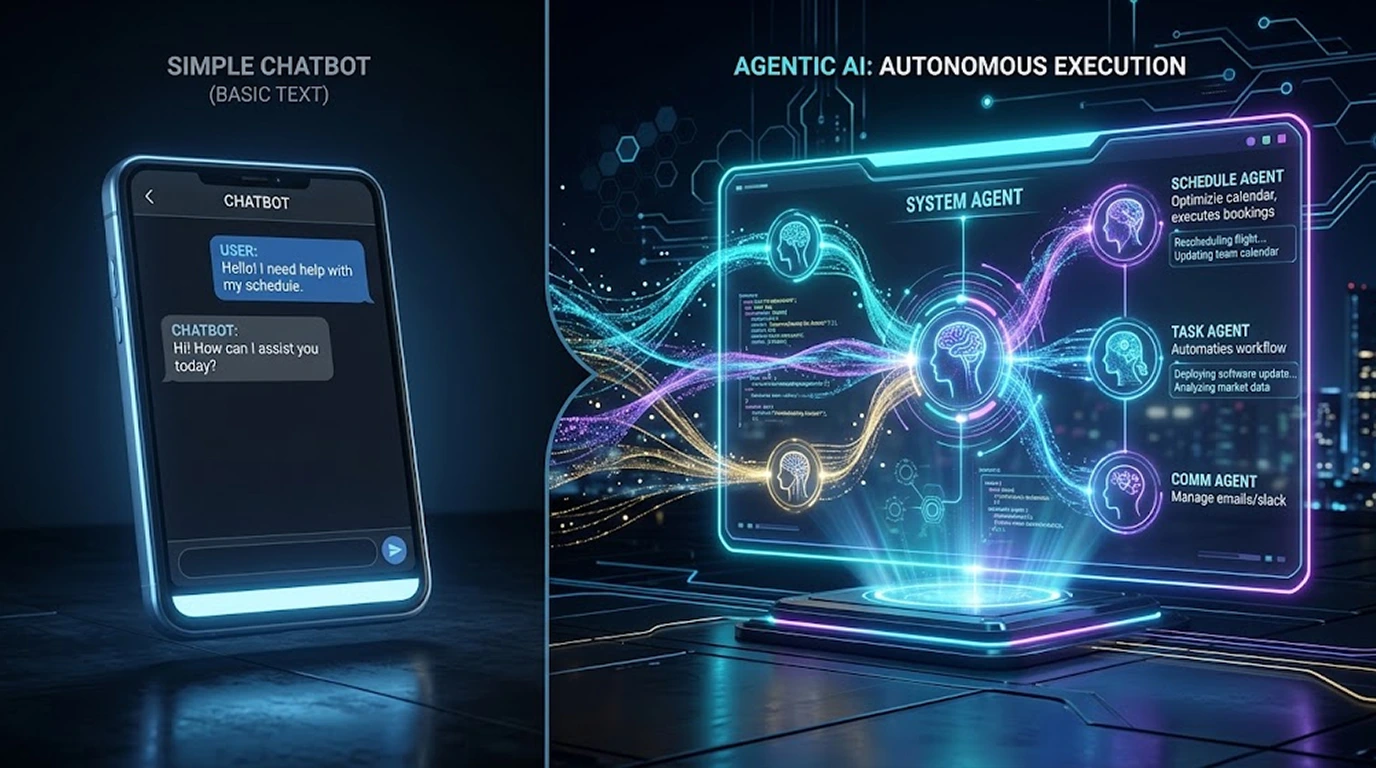
That's the difference between chatbots and agentic AI.
A chatbot is reactive. You ask it something, it responds. You give it instructions, it follows them. But it stops there. It doesn't take initiative. It doesn't keep working when you're not watching. It doesn't figure things out on its own.
Agentic AI is proactive. It is given an objective to pursue, and then works on how to meet that objective. It works on its own. It makes choices for itself, it can also adapt to unexpected situations. It keeps going until the job is done.
This is the big shift that's happening right now.
The Chatbot Era: What We've Been Using
Let's be fair to chatbots. They've been incredibly useful.
ChatGPT, Claude, Gemini these tools have transformed how we work. They write drafts, answer questions, summarize documents, brainstorm ideas, and help with research.
But here's what chatbots do:
They respond to prompts. They generate content. They provide information. They suggest ideas.
And then they stop.
You have to be there. You have to give the next instruction. You have to take whatever they produce and actually do something with it.
The chatbot doesn't book the meeting. It doesn't send the email. It doesn't update the spreadsheet. It doesn't trigger the workflow.
You do all that.
Chatbots are amazing at giving you information. But they're terrible at getting things done.
That's where agentic AI comes in.
What Makes Agentic AI Different
Agentic AI takes everything chatbots do and adds action.
Here are some things that agentic AI can do that chatbots cannot:
It Initiates Actions
You tell agentic AI what your goal is, and then it determines how to accomplish that goal without having you guide it every step of the way.
It Operates Independently
The Agentic AI keeps operating regardless of whether you are watching it or not. It can be able to gather data, make decisions and take action on its own.
Adaptation to Change
If anything changes in the process of doing something, the agentic AI adapts. It doesn't just stop and wait for new instructions. It figures out workarounds.
It Executes Tasks
Agentic AI doesn't just give you recommendations. It actually performs tasks. It sends emails. It updates databases. It triggers workflows. It makes things happen.
It Learns Over Time
Agentic AI gets better with experience. It evolves from its successes and failures. It improves its method.
The point is that a chatbot is comparable to an intern giving you advice while agentic AI resembles an employee doing real work for you.
Real-World Examples of Agentic AI
Let me give you some concrete examples so you can see the difference.
Customer Service
The chatbot assists customers in resolving questions. It gives information. It gives solutions.
Agentic AI is responsible for managing the entire process from start to finish. Agentic AI understands the question asked, performs research on the question, identifies the problem, develops a solution, contacts the customer, and files away the information, and that too without any human intervention.
Sales
The chatbot provides details on the product. It assists in answering queries and providing solutions.
Agentic AI finds the prospects, analyzes their needs, communicates with them through a personalized message, follows up, schedules appointments, and prepares proposals.
Operations
The chatbot answers questions related to inventory. It offers status reports. It aids in research activities.
Agentic AI keeps track of inventory, anticipates demand, makes purchases when inventory is depleted, interacts with suppliers, plans for deliveries, and ensures updates.
Human Resources
A chatbot answers employees’ queries. It informs employees about policies. It assists in basic inquiries.
Agentic AI recruits, interviews, follows up, processes paperwork, and onboards candidates.
The pattern is the same everywhere. Chatbots talk. Agentic AI acts.
Why 2026 Is the Year of Agentic AI
You might be wondering, "If agentic AI is so great, why are we just hearing about it now?"
Good question.
This technology has been in development for quite some time now, but there are three developments in 2026 that have combined to make agentic AI practical and viable.
Superior Reasoning Capabilities
Previous artificial intelligence technologies were able to produce content, but were unable to reason through complex problems. Current technology is much more capable of understanding the goal and executing step by step processes.
Improved Execution
Early AI agents were unreliable. They'd make mistakes, get stuck, or produce unpredictable results. The reliability has improved dramatically.
Integration With Business Systems
Agentic AI can now connect with the tools businesses actually use; email, CRMs, databases, calendars, project management software.
These three factors have made agentic AI genuinely useful for real business workflows.
The Shift Every Business Should Pay Attention To
This isn't just a cool technology trend. It's a fundamental shift in how work gets done.
Companies that adopt agentic AI would be in a position to:
Get more work done with fewer people
React to customer inquiries more rapidly
Take decisions faster
Decrease human error
Increase capacity without adding staff
Firms that do not will find it hard to compete.
This is the typical pattern that accompanies every major technological revolution. The businesses that adopt early gain a lasting advantage.
But Wait, Isn't This Just Automation?
This is a common question. And it's a good one.
Automation has been around forever. Businesses have been automating repetitive tasks for decades.
So what makes agentic AI different?
Traditional automation follows fixed rules. You program exactly what to do in every situation. When something unexpected happens, the automation breaks.
Agentic AI can handle novel situations. It can adapt to change. It can make judgment calls. It can figure things out when the path isn't obvious.
Traditional automation is like a train on tracks. Agentic AI is like a driver with a destination.
That's a huge difference.
Challenges and Risks Associated with Agentic AI
But let us not forget about its disadvantages.
Problem of Trust
Giving autonomy to AI raises the problem of trust. What will happen in case it makes an incorrect decision? What if it takes an unexpected action?
Control Concerns
How do you keep agentic AI aligned with your goals? How do you make sure it doesn't go off in the wrong direction?
Implementation Complexity
The implementation of an agent-based AI is not a straightforward process like just switching a chatbot on.
Concerns Over Job Security
When AI performs tasks that were earlier done by people, there arise some legitimate concerns regarding job security.
These are real issues that need to be addressed. But they're not reasons to avoid agentic AI. They're reasons to approach it thoughtfully.
What This Means for Your Business
Here's the practical takeaway.
If you're using chatbots, you're already on the AI journey. That's great. But don't stop there.
Begin to think about where agentic AI could be used in your business.
Tasks that may have agentic AI applications would be those which are:
Repetitive and time consuming
Rule based with some variations
Important but not a core part of your competitive advantage
Scalable through automation
Start small. Pick one workflow. Test agentic AI on it. Learn from the experience. Then expand.
The companies that figure this out first will have a massive advantage.
FAQ Section
How is agentic AI different from chatbots?
Chatbots operate through prompts and provide information. Agentic AI works by self-motivated actions, decision-making and task completion. Chatbots talk. Agentic AI acts.
What is it that agentic AI is able to do but chatbots can't?
The ability of agentic AI to work autonomously, adapt to new situations, act autonomously, perform actions such as sending emails and updating databases and learn from experience over time.
Why does the year 2026 mark the year of agentic AI?
Reasoning skills, increased reliability of its actions, and incorporation into corporate systems make agentic AI possible and affordable in 2026.
Is agentic AI the same as automation?
Not really. Automation has been built using pre-set rules, which fail to deliver results once there is any shift in environment. Agentic AI operates in unpredictable environment and draws conclusions.
How can agentic AI be used in business processes?
Customer services, sales, operations, HR management, marketing, etc. Basically, any process that requires repetitive execution following certain set of rules might become a subject of agentic AI.
Can agentic AI create problems for businesses?
Sure. Problems regarding trust, control issues, difficulty of implementation, and job losses should be addressed.
Will agentic AI replace human workers?
It will change how work gets done. Some tasks will be automated. Yet new roles and new possibilities will arise too. Adaptation is the important factor.
How do I get started with agentic AI?
Start small. Pick one workflow. Test agentic AI on it. Learn from the experience. Then expand to other areas.